

Kilde bilde: pixabay
Mange er i dag fortvilet over at det er kommet en ny versjon av Snapchat. Dette har også skjedd på Facebook og dette er ikke bra. Folk liker ikke forandring. Det eneste som er sikkert her i verden at alt som er på mobiler, pc`er og nett vil alltid være i kontinuerlig forandring.
I søken etter å få tak i gammel Snapchat versjon så har man nå funnet mange VPN løsninger som skal løse problemet. Nå skal jeg fortelle hvorfor det er en dårlig ide.
Først. Hva er VPN?
Virtual private Network (VPN), på norsk; virtuelt privat datanettverk, er betegnelsen på en datateknikk som anvendes for å skape «punkt-til-punkt»-forbindelser, såkalte «tunneler», gjennom et annet datanett. Kilde. Wikipedia
Tipset som florerer nå på nett er som følger:
Hvordan få tilbake gammel Snapchat.
- Last ned x-VPN eller vpn360 fra app store
- Åpne appen, Trykk allow på push varsel og connect.
- Gå inn på snap og send en random snap
- Lukk alle apper
- Åpne VPN igjen og disconnect.
- Åpne snap og Voila.
Det er som er dumt her. Folk blir desperate. De sjekker ikke vilkår når de laster ned nye appert bli problemer.
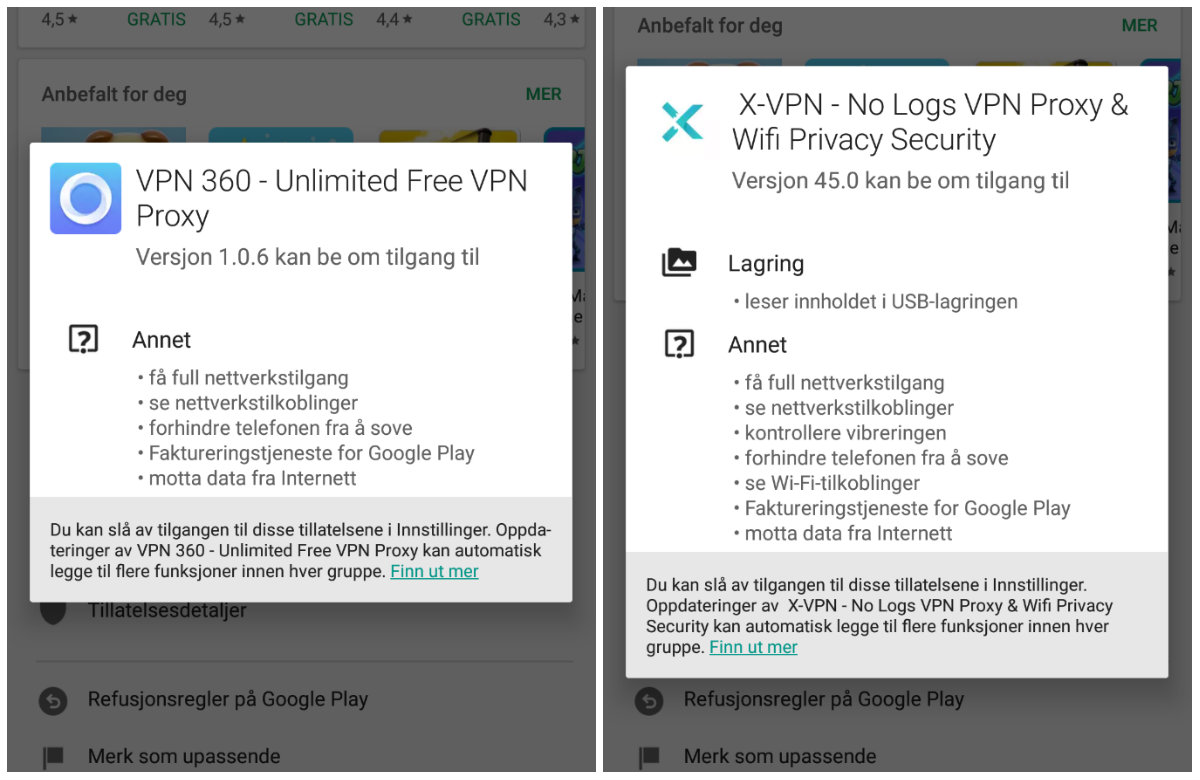
Det jeg ikke liker her er at begge skal ha tilgang til google sin fakturerings tjeneste. Dermed kan de fakturere deg for bruk når det skal være rett på kortet ditt som du har på konto. De sier også at de når som helst kan legge til nye funksjoner i appene. Så med andre ord har du lite kontroll her. Du vet heller ikke hvilke firma som står bak eller hvor dataene sendes.
VPN i dette tilfelle er en falsk trygghet. Du mister kontroll over dine egne data og du risikerer og bli fakturert for en ekstra VPN tjeneste.
Dessuten så er dataene dine sporbare, men de går bare via andre servere på nettet:
No, seriously, don’t. You’re probably reading this because you’ve asked what VPN service to use, and this is the answer.
Note: The content in this post does not apply to using VPN for their intended purpose; that is, as a virtual private (internal) network. It only applies to using it as a glorified proxy, which is what every third-party “VPN provider” does.
- A Russian translation of this article can be found here, contributed by Timur Demin.
- A Turkish translation can be found here, contributed by agyild.
- There’s also this article about VPN services, which is honestly better written (and has more cat pictures!) than my article.
Because a VPN in this sense is just a glorified proxy. The VPN provider can see all your traffic, and do with it what they want – including logging.
There is no way for you to verify that, and of course this is what a malicious VPN provider would claim as well. In short: the only safe assumption is that every VPN provider logs.
And remember that it is in a VPN provider’s best interest to log their users – it lets them deflect blame to the customer, if they ever were to get into legal trouble. The $10/month that you’re paying for your VPN service doesn’t even pay for the lawyer’s coffee, so expect them to hand you over.
I’ll believe that when HideMyAss goes out of business. They gave up their users years ago, and this was widely publicized. The reality is that most of their customers will either not care or not even be aware of it.
Doesn’t matter. You’re still connecting to their service from your own IP, and they can log that.
VPNs don’t provide security. They are just a glorified proxy.
VPNs don’t provide privacy, with a few exceptions (detailed below). They are just a proxy. If somebody wants to tap your connection, they can still do so – they just have to do so at a different point (ie. when your traffic leaves the VPN server).
Use SSL/TLS and HTTPS (for centralized services), or end-to-end encryption (for social or P2P applications). VPNs can’t magically encrypt your traffic – it’s simply not technically possible. If the endpoint expects plaintext, there is nothing you can do about that.
When using a VPN, the only encrypted part of the connection is from you to the VPN provider. From the VPN provider onwards, it is the same as it would have been without a VPN. And remember, the VPN provider can see and mess with all your traffic.
Your IP address is a largely irrelevant metric in modern tracking systems. Marketers have gotten wise to these kind of tactics, and combined with increased adoption of CGNAT and an ever-increasing amount of devices per household, it just isn’t a reliable data point anymore.
Marketers will almost always use some kind of other metric to identify and distinguish you. That can be anything from a useragent to a fingerprinting profile. A VPN cannot prevent this.
There are roughly two usecases where you might want to use a VPN:
- You are on a known-hostile network (eg. a public airport WiFi access point, or an ISP that is known to use MITM), and you want to work around that.
- You want to hide your IP from a very specific set of non-government-sanctioned adversaries – for example, circumventing a ban in a chatroom or preventing anti-piracy scareletters.
In the second case, you’d probably just want a regular proxy specifically for that traffic – sending all of your traffic over a VPN provider (like is the default with almost every VPN client) will still result in the provider being able to snoop on and mess with your traffic.
However, in practice, just don’t use a VPN provider at all, even for these cases.
If you absolutely need a VPN, and you understand what its limitations are, purchase a VPS and set up your own (either using something like Streisand or manually – I recommend using Wireguard). I will not recommend any specific providers (diversity is good!), but there are plenty of cheap ones to be found on LowEndTalk.
A VPN provider specifically seeks out those who are looking for privacy, and who may thus have interesting traffic. Statistically speaking, it is more likely that a VPN provider will be malicious or a honeypot, than that an arbitrary generic VPS provider will be.
Because it’s easy money. You just set up OpenVPN on a few servers, and essentially start reselling bandwidth with a markup. You can make every promise in the world, because nobody can verify them. You don’t even have to know what you’re doing, because again, nobody can verify what you say. It is 100% snake-oil.
So yes, VPN services do serve a purpose – it’s just one that benefits the provider, not you.
This post is licensed under the WTFPL or CC0, at your choice. You may distribute, use, modify, translate, and license it in any way.
Comments have been disabled: Due to the overwhelming amount of spam comments, the comments under this post are no longer available. If you wish to provide feedback on the article, send me an e-mail instead!
Her er en bedre forklaring på engelsk. Fant dessverre ikke samme versjon på norsk. Uansett så er VPN bare en kortere fiks. Når Snapchat har oppdatert alle sine servere til nyeste versjon så er det ingen vei tilbake. Da blir du værende på siste versjon
For andre artikler se her, også sjekk ut oss på sosiale medier Facebook og Twitter.